Learning materials for your class.
Create printables and presentations with beautiful and accurate images. Engage with your class while communicating complex concepts in science and technology
Join our teacher community
If you are a teacher, we would love to hear from you. Join our discord channel to reach us and share your thoughts.
Three great formats
You can create visual books in 3 different formats based on your usecase. All of them come with images.
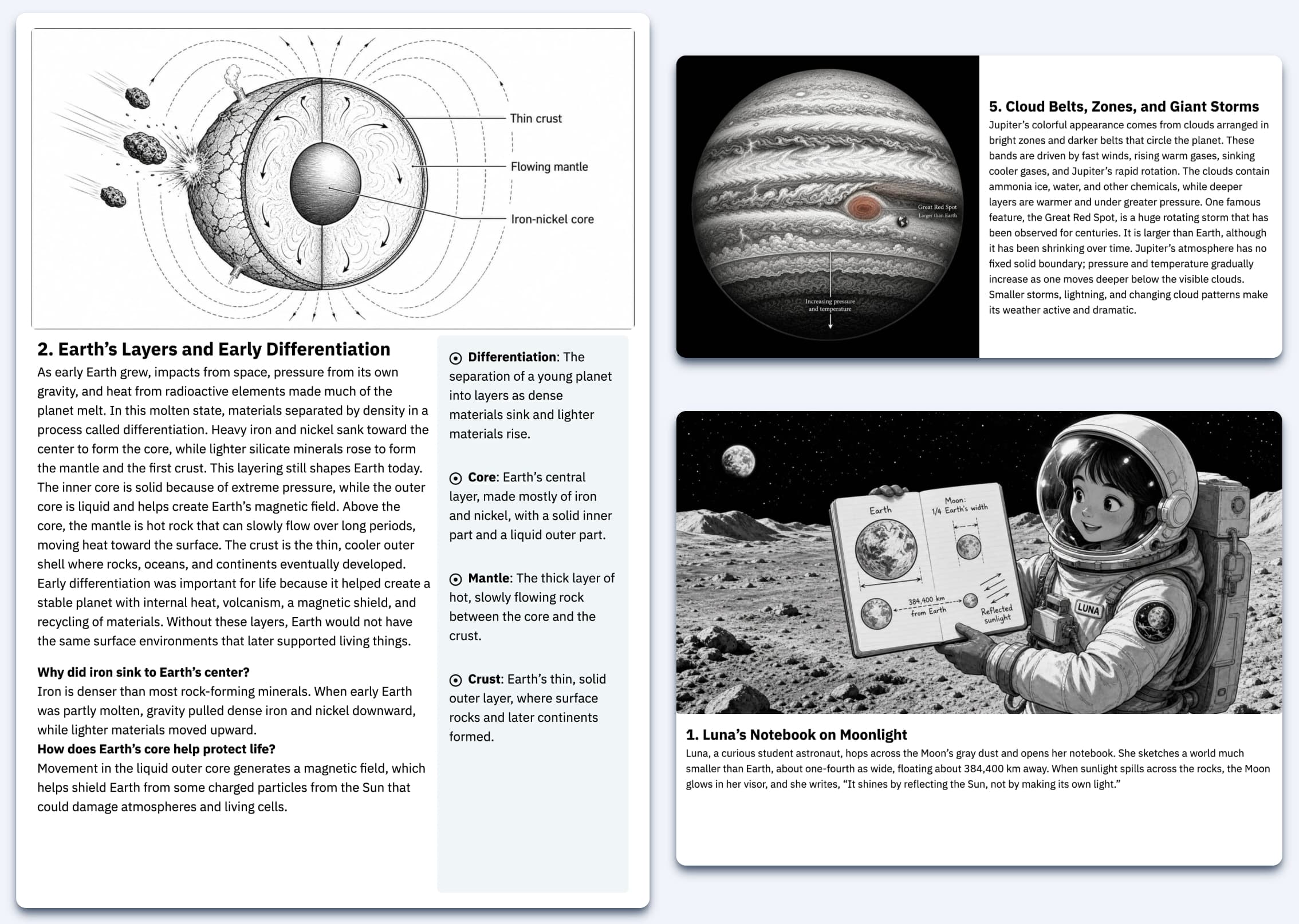
A4
Printable on an A4 sheet and the most verbose of all. Comes packed with information, FAQs and definitions.
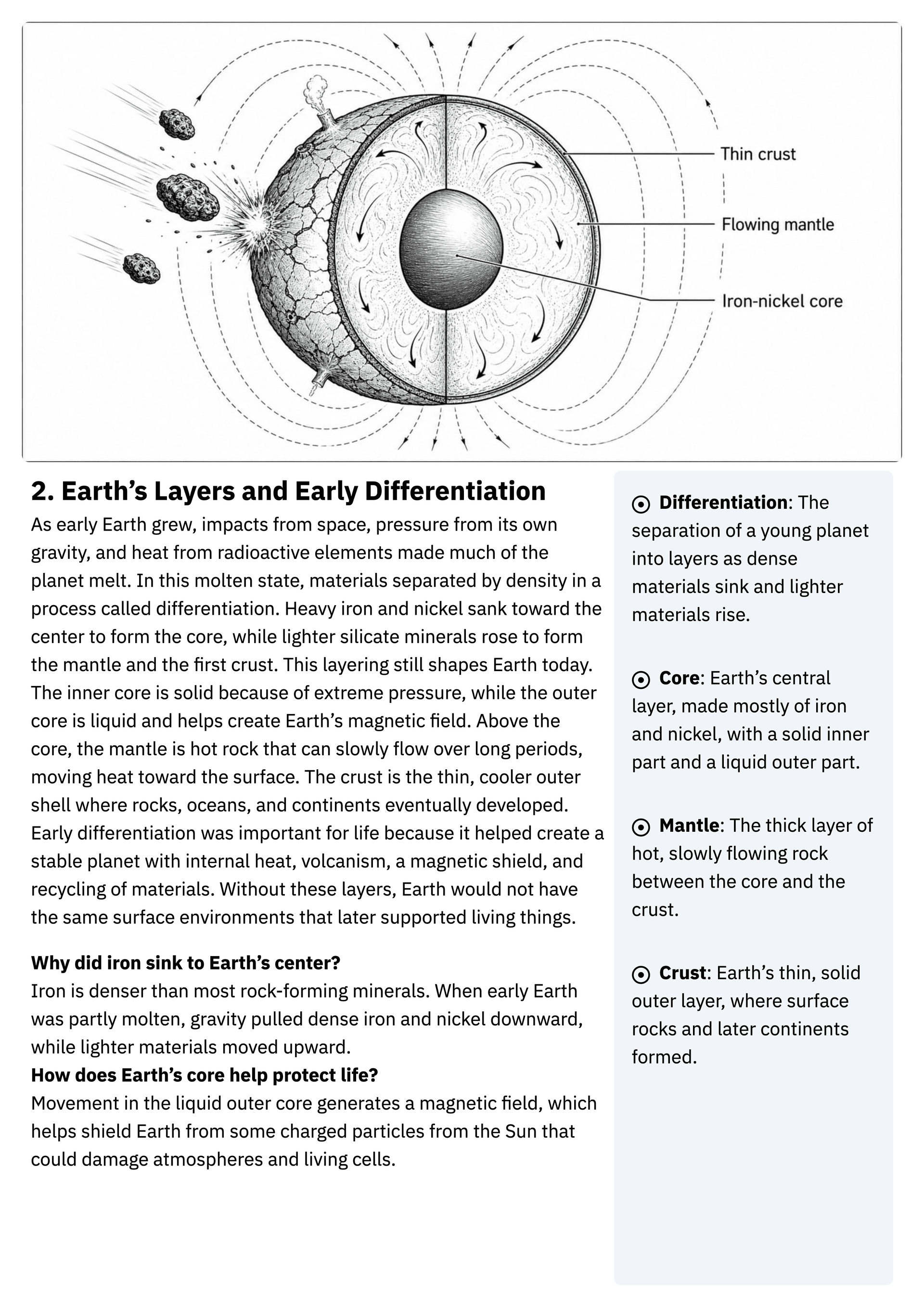
2x1
An equal balance between image and text. Great for a class presentation. You can also swap images for charts.
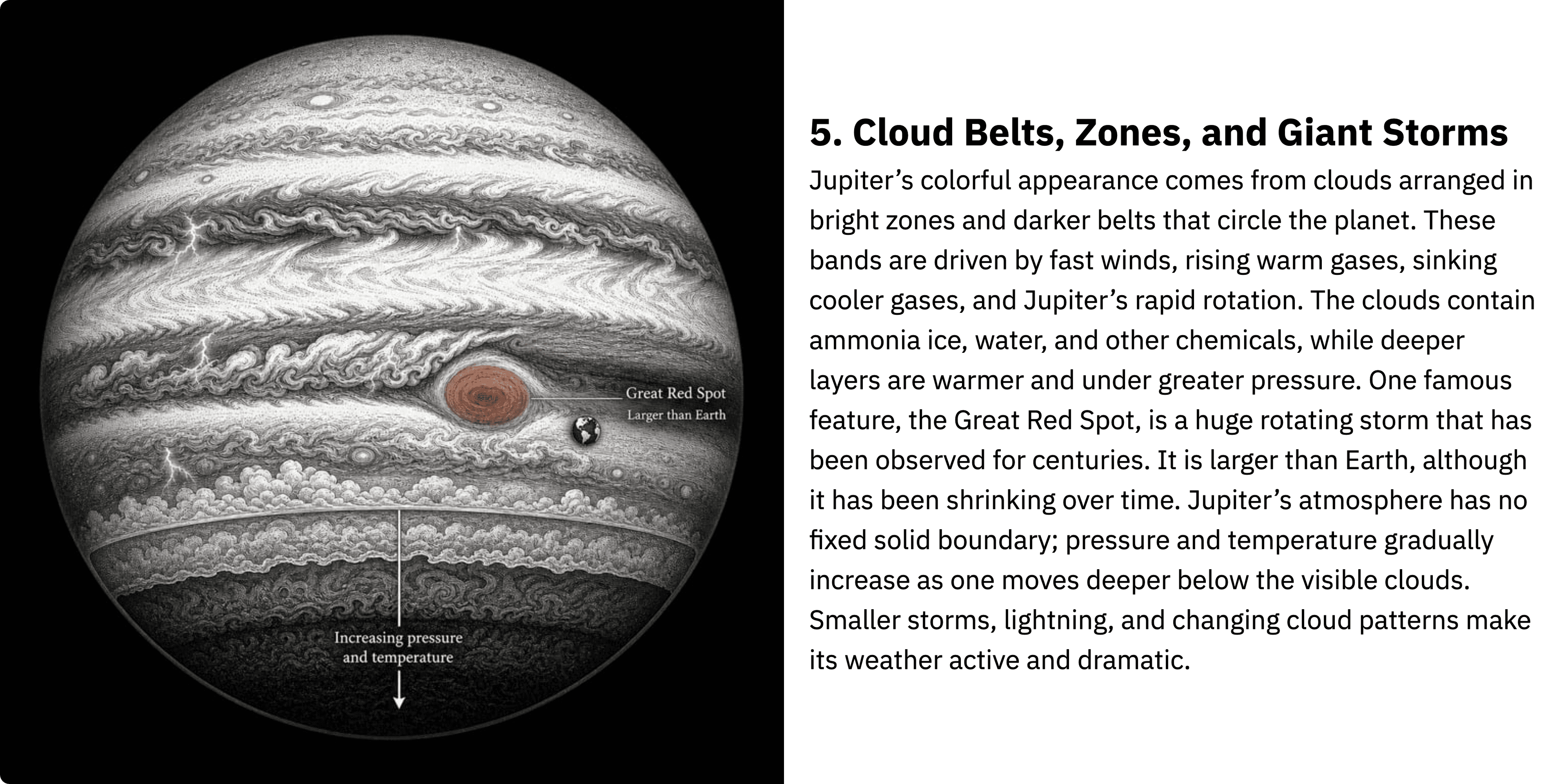
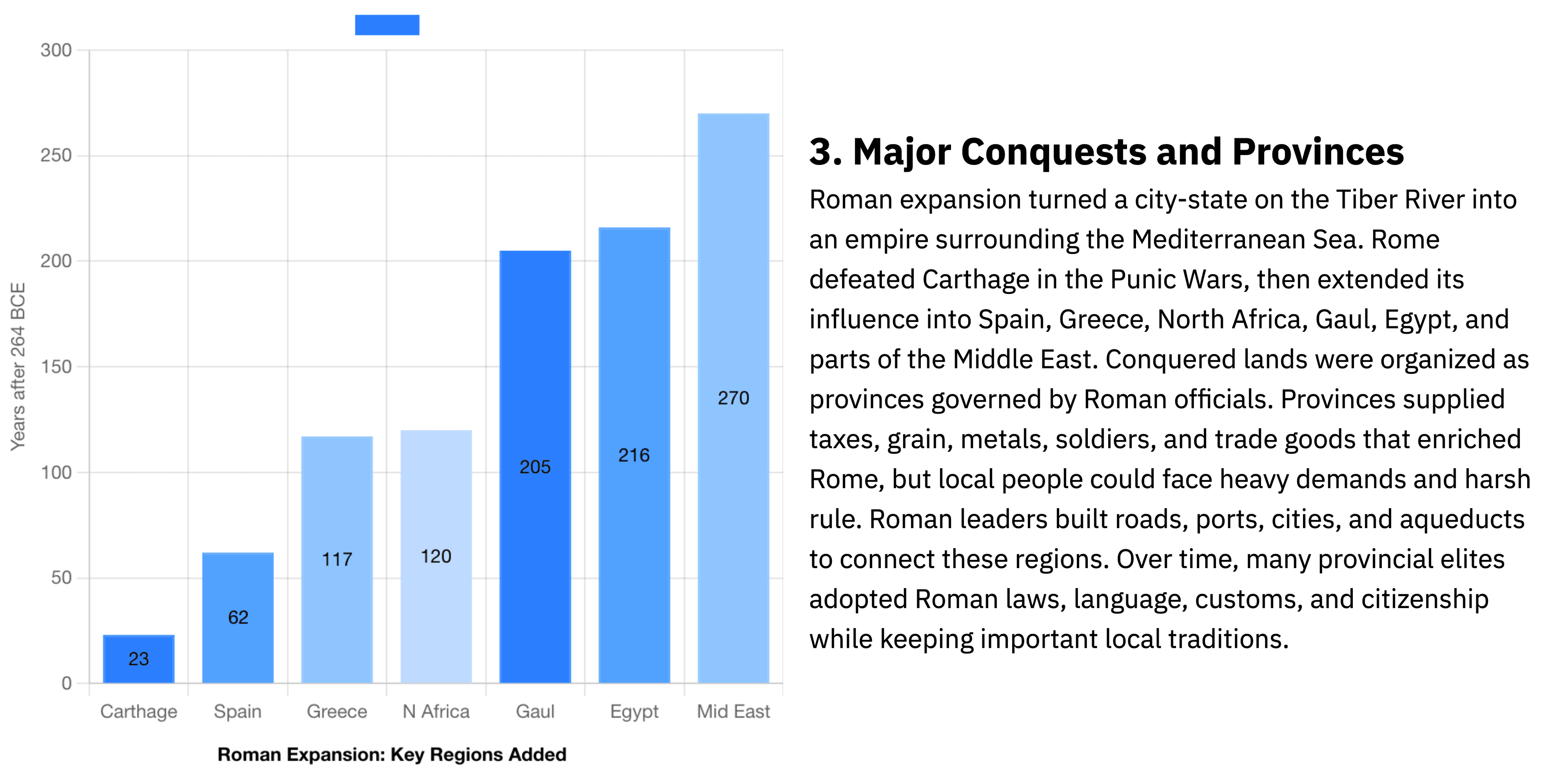
4x3
When the image matters more than the text. This presentation format has a wide image that perfect for kids
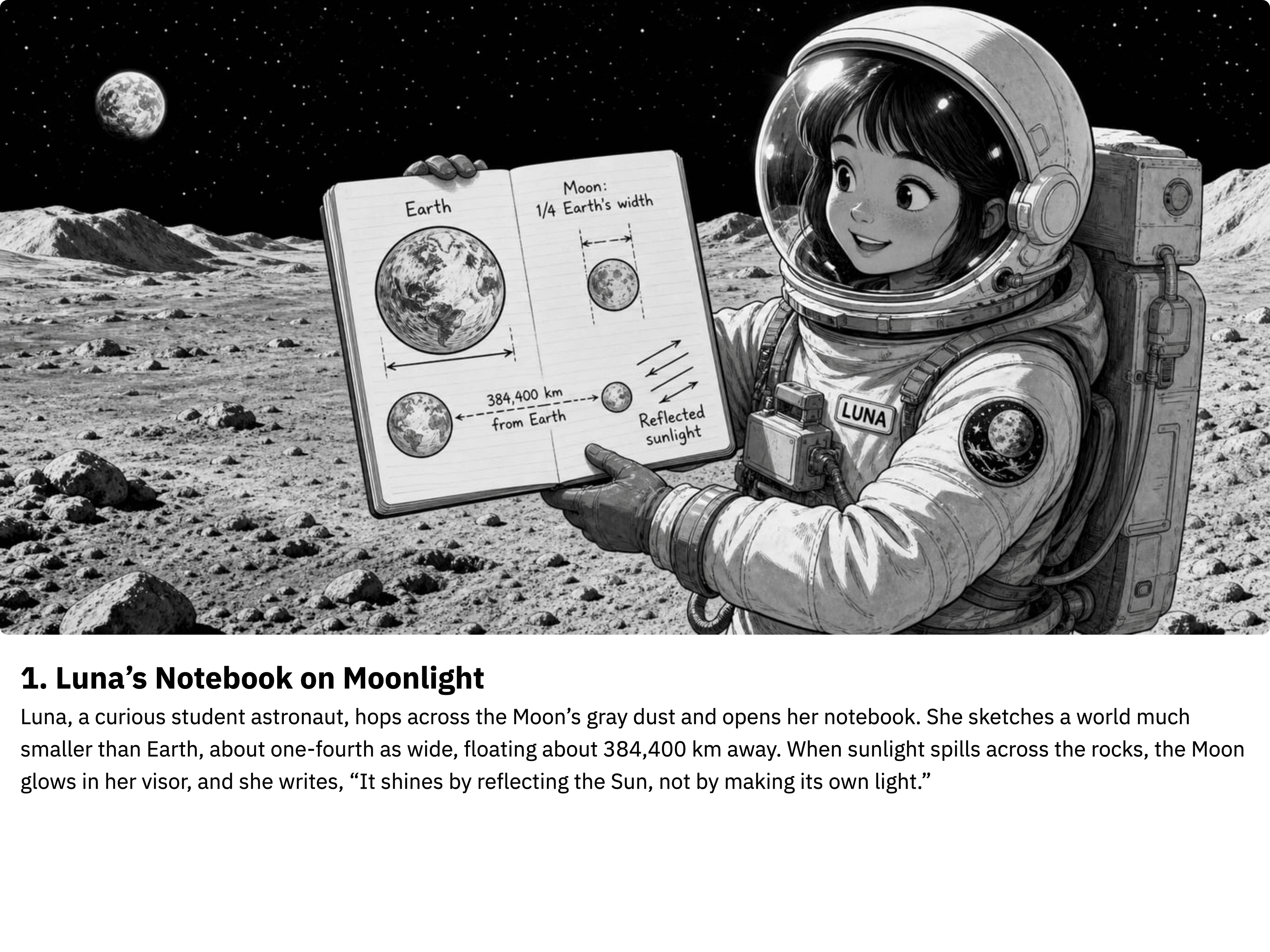
Tell a story
With story mode you can create character based stories to explain the most complex ideas to kids of all ages
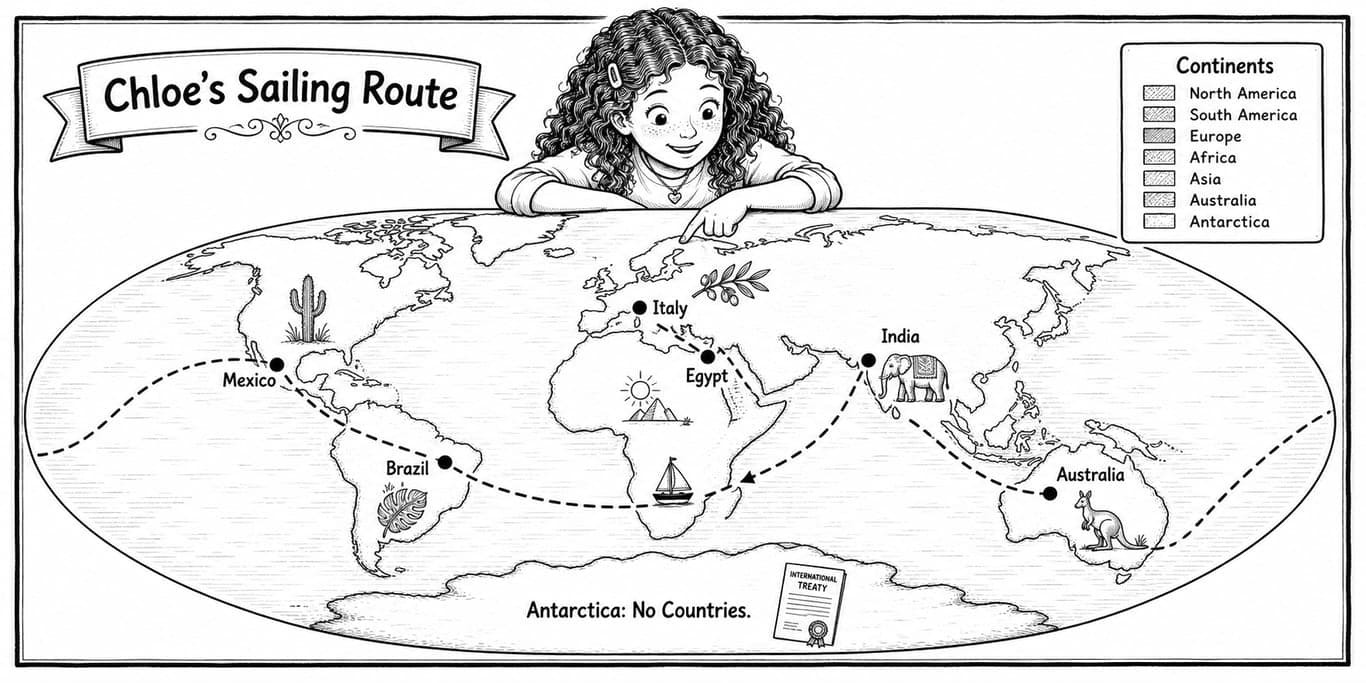
Create books by learning level
From middle school to postgraduate align the complexity of the material with a specific age group
Explore Public Books
These books have been created by users of visual book and shared publicly with the world.
Science
Undegraduate
An undergraduate introduction to special relativity, covering Einstein’s postulates, reference frames, Lorentz transformations, simultaneity, time dilation, length contraction, and velocity addition.
High School
Learn how forces affect motion through Newton’s three laws. Explore inertia, acceleration, action–reaction pairs, free-body diagrams, gravity, friction, and practical problem-solving.
Middle School
Explore how the Sun, Earth, and Moon line up to create eclipses. Learn about shadows, solar and lunar eclipse types, why eclipses are uncommon, and how to observe them safely.
Mathematics
Undegraduate
An undergraduate introduction to probability theory covering sample spaces, events, counting, conditional probability, random variables, distributions, expectation, variance, and common probability laws.
High School
A high school introduction to trigonometry covering angle measures, right-triangle ratios, the unit circle, common values, function graphs, identities, and practical problems involving heights and distances.
Middle School
Students explore fractions, decimals, and percentages; compare and calculate with each form; convert among them; and solve everyday problems involving prices, parts of a whole, and discounts.
Technology
Undegraduate
An undergraduate introduction to neural networks, covering artificial neurons, weights, activation functions, layers, training with backpropagation, and the advantages of deep models for complex tasks.
High School
An accessible introduction to machine learning for high school students. Learn how supervised, unsupervised, and reinforcement learning use data, labels, patterns, actions, and rewards in daily-life examples.
Middle School
Explore what artificial intelligence means, where students encounter it, and how it differs from ordinary rule-based computer programs. Learn AI's strengths, limits, and responsible use.
Social Sciences
High School
Explore how ancient and early modern travelers crossed oceans using landmarks, winds, stars, maps, compasses, and instruments. Compare Polynesian, Viking, Asian, and European navigation traditions.
Undegraduate
An undergraduate introduction to how economies produce goods, allocate scarce resources, trade through markets, and use money and banking to coordinate exchange and influence prices.
High School
This presentation explores how Roman wars built and strained an empire, how engineering transformed daily life, and how law, citizenship, religion, and class reshaped Roman society.
Middle School
Explore Earth’s countries, continents, landmasses, landforms, and five oceans. Learn to read world maps and discover how borders, capitals, land, and water shape our planet.
Environment
Undegraduate
An undergraduate introduction to air pollution, covering pollutant sources and chemistry, atmospheric transport, health and environmental impacts, measurement methods, regulation, and mitigation technologies.
High School
An accessible introduction to long-term shifts in Earth’s temperature and weather. Students examine causes, evidence, impacts on people and nature, and practical mitigation and adaptation solutions.
Middle School
Students explore how organisms and nonliving surroundings form ecosystems. They learn roles in food webs, relationships, adaptations, and practical ways people can protect ecosystems.
Get in touch
We are eagerly waiting for your email at our headquarters on Titan. Don't worry, our advanced interplanetary network is blazing fast!