 Maya on Mars
Slideshow
Edit
1. Red Morning
2. Cold Truth
3. Low-Gravity Steps
4. Dust That Bites
5. Invisible Radiation
6. The Perchlorate Problem
7. Water, Carefully Found
8. Air From CO₂
9. Power Is Survival
10. Food Under Glass
11. The Long Supply Chain
12. Communication Delay
13. Habitat as Machine
14. Why Stay?
Environment
1. Red Morning
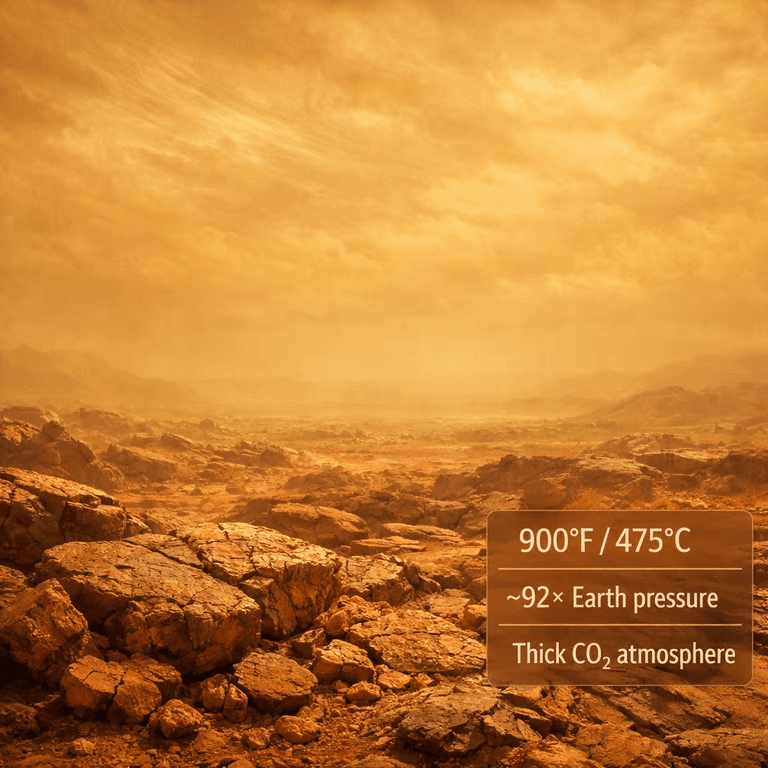
Maya wakes to a salmon sky that never turns blue. Mars’ thin air is mostly CO₂ with surface pressure under 1% of Earth’s, so liquid water is unstable and sound carries weakly. She steps through an airlock because even a brief helmet leak can mean hypoxia and boiling of moisture at low pressure—survival here begins with sealing yourself from the planet.
2. Cold Truth
Her thermometer reads far below freezing; Mars is cold because it’s farther from the Sun and has a thin atmosphere that can’t trap much heat. Day-night swings are large, so systems must handle rapid thermal cycling that cracks seals and stresses materials. Maya learns that warmth is an engineering product, not a weather forecast.
3. Low-Gravity Steps
Walking feels springy; Mars’ gravity is about 38% of Earth’s, so Maya can carry more mass but must relearn balance and momentum. Tools float longer in arcs, falls happen slower, and muscles and bones still weaken over time. Low gravity helps with lifting and launching, yet makes long-term health and construction methods uncertain.
Hazards
4. Dust That Bites
A dust devil crawls across the plain, electrostatically clinging to her suit joints. Martian dust is fine, abrasive, and can infiltrate bearings and seals, degrading habitats and rovers. Storms can shroud sunlight for weeks, threatening solar power. Maya treats dust like a slow poison: manageable daily, dangerous if ignored.
5. Invisible Radiation
At the clinic, Maya checks her dose badge. Mars lacks a global magnetic field and has little atmospheric shielding, so cosmic rays and solar particle events reach the surface more readily. Radiation raises cancer risk and can damage electronics. Habitats need shielding—often by burying modules under regolith—turning geology into medicine.
6. The Perchlorate Problem
Maya samples soil and flags it for caution. Many Martian soils contain perchlorate salts, which can disrupt thyroid function and complicate farming. They also interfere with some life-detection tests and can corrode equipment. Any plan to grow crops or use local dirt for building must include washing, heating, or other treatment steps.
Resources
7. Water, Carefully Found
On an EVA, Maya scans for subsurface ice where sunlight never reaches. Mars has water ice at the poles and in buried deposits, but accessing it means drilling, heating, and filtering. Water is life support, agriculture, and chemistry feedstock, so every liter is tracked. On Mars, finding water is only half the battle—processing it is the other half.
8. Air From CO₂
Back at the plant, Maya watches a unit split CO₂ to make oxygen for breathing and oxidizer for rockets. Mars gives plenty of carbon dioxide, but turning it into useful products costs energy, maintenance, and redundancy. A single clogged intake can threaten the whole settlement, so they design systems like life-critical spacecraft, not casual factories.
9. Power Is Survival
Maya’s schedule revolves around kilowatt-hours. Solar is simple but vulnerable to dust and winter light; nuclear is steady but complex to launch and safeguard. Every subsystem—heating, pumps, air recycling, communications—competes for power. Colonization is difficult because energy scarcity turns minor failures into cascading emergencies.
Colonization Challenges
10. Food Under Glass
In the greenhouse, Maya trims lettuce grown under LEDs. Plants need controlled temperature, pressure, light, water, and nutrients; Martian sunlight is weaker and storms can cut it further. Closed-loop farming must also manage microbes and pollen in confined air. A colony can’t simply “plant seeds in soil”—it must build an Earth-like biosphere in boxes.
11. The Long Supply Chain
A replacement valve arrives months late, reminding Maya that resupply windows depend on planetary alignment and limited cargo mass. Shipping heavy parts is costly, so the base relies on spares, repairs, and local manufacturing—yet printers still need feedstock and quality control. Mars punishes improvisation because the next shipment isn’t next week; it’s next launch opportunity.
12. Communication Delay
Maya sends a video to her family and waits; depending on where Earth and Mars are in their orbits, messages can take minutes each way. Real-time conversations, remote surgery, and live troubleshooting are often impossible. The crew must be more autonomous than any Earth team, and loneliness becomes a technical constraint as real as oxygen.
13. Habitat as Machine
During a drill, Maya seals bulkheads and reroutes air like a ship in a storm. A Mars habitat is a pressure vessel with constant leak checks, filtration, humidity control, and fire safety in confined spaces. One puncture can be fatal, so walls, windows, and suits are engineered like aerospace hardware. Living space is life support first, comfort second.
Reflection
14. Why Stay?
On a ridge at sunset, Maya records a lesson: Mars is harsh—cold, dry, irradiated, dusty—but it also offers knowledge, testing grounds, and resources that can be shaped with enough energy and care. Colonization is difficult not because one big problem exists, but because many small, unforgiving constraints stack together. Progress is the art of managing them daily.


 Maya on Mars