 Black Holes
Slideshow
Edit
1. What a black hole is (core idea)
2. Key size scale: the Schwarzschild radius
3. How stellar black holes form (core-collapse)
4. Direct collapse vs. supernova fallback
5. Supermassive black holes in galaxy centers
6. Event horizon: the point of no return
7. Singularity and the limits of current physics
8. Spinning (Kerr) black holes and the ergosphere
9. Accretion disks: why black holes shine
10. Relativistic jets and feedback
11. How we detect black holes (indirect methods)
12. Gravitational waves from black hole mergers
13. Black hole “images” and the shadow
14. Tidal forces and spaghettification (visual intuition)
15. Why black holes matter for physics
Basics
1. What a black hole is (core idea)
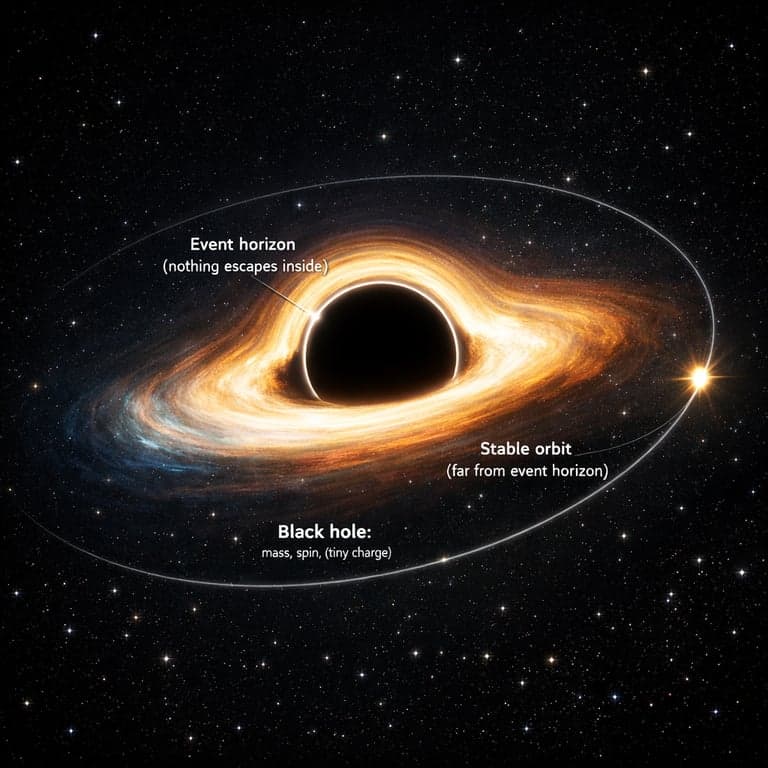
A black hole is a region of spacetime where gravity is so strong that, inside a boundary called the event horizon, nothing that carries information (including light) can escape to the outside. It is not a “cosmic vacuum cleaner”; far away it attracts like any other mass. Black holes are described by general relativity and characterized by mass, spin, and (usually negligible) charge.
2. Key size scale: the Schwarzschild radius
Loading equations
Formation
3. How stellar black holes form (core-collapse)
Many black holes form when a massive star exhausts nuclear fuel and its core collapses. If the remaining core mass is high enough, pressure forces cannot halt collapse, producing a black hole, often after a supernova. Typical stellar black holes are a few to tens of solar masses; exact outcomes depend on initial mass, metallicity, rotation, and mass loss to winds or binary transfer.
4. Direct collapse vs. supernova fallback
Not all black holes are born the same way: some may form by “failed supernova” direct collapse, where the star dims without a bright explosion, while others grow by fallback, where ejected material fails to escape and later falls back onto the compact remnant, increasing its mass. These channels help explain a range of black hole masses and why some explosions are faint or missing.
5. Supermassive black holes in galaxy centers
Most large galaxies appear to host supermassive black holes (millions to billions of solar masses) at their centers. How they formed is an active topic: possibilities include growth from smaller “seed” black holes via gas accretion and mergers, or early “direct collapse” of massive gas clouds. Their mass correlates with properties of the host galaxy bulge, hinting at co-evolution.
Key features
6. Event horizon: the point of no return
The event horizon is not a physical surface; it is a boundary in spacetime. To an outside observer, signals from infalling matter appear increasingly redshifted and delayed near the horizon, while the infaller experiences crossing it without a local “wall” (ignoring tidal forces). The horizon’s existence is why black holes can hide information from the external universe in classical physics.
7. Singularity and the limits of current physics
Classical general relativity predicts a singularity—an inner region where curvature becomes infinite and known physics breaks down. This is widely interpreted as a sign that quantum gravity is needed. Importantly, the singularity is not directly observable from outside in standard black hole models because the event horizon prevents signals from escaping, linking singularities to “cosmic censorship” ideas.
8. Spinning (Kerr) black holes and the ergosphere
Most astrophysical black holes likely spin. A spinning black hole has an outer event horizon and an ergosphere, a region outside the horizon where spacetime is dragged around (“frame dragging”). In the ergosphere, no object can remain stationary relative to distant stars. Spin affects the innermost stable orbit of accretion disks and can help launch powerful jets in active galaxies.
Observational evidence
9. Accretion disks: why black holes shine
Black holes themselves emit no light, but gas falling toward them can form an accretion disk that heats up via friction and magnetic turbulence, radiating strongly in X‑rays/UV. Some of the brightest objects in the universe—quasars—are powered by accretion onto supermassive black holes. Observing disk emission and variability helps infer black hole mass and spin indirectly.
10. Relativistic jets and feedback
Some accreting black holes produce narrow, near‑light‑speed jets that can extend far beyond their host galaxy. Jets likely involve magnetic fields anchored in the disk and energy extracted from accretion and/or black hole spin. This “feedback” can heat or expel gas, influencing star formation and shaping galaxy evolution, making black holes important even on cosmological scales.
11. How we detect black holes (indirect methods)
We infer black holes by their gravitational effects: tracking the orbits of nearby stars or gas (e.g., fast stellar orbits around the Milky Way’s center), observing X‑ray binaries where a compact object pulls gas from a companion, and modeling accretion disk spectra. If the compact object exceeds the maximum neutron‑star mass, a black hole is the favored explanation.
12. Gravitational waves from black hole mergers
Merging black holes emit gravitational waves—ripples in spacetime—detected by observatories like LIGO/Virgo/KAGRA. The waveform encodes the masses and spins and tests general relativity in strong gravity. These observations revealed populations of stellar‑mass black holes in binaries and showed that black holes can merge repeatedly, building heavier remnants and probing how binaries form.
13. Black hole “images” and the shadow
The Event Horizon Telescope (a global radio interferometer) can resolve the bright ring and central “shadow” caused by light-bending near the horizon of supermassive black holes. The shadow is not the horizon itself but a lensed silhouette of photon capture. Such images test predictions of strong-field gravity and constrain accretion and magnetic field models close to the black hole.
Intuition & visuals
14. Tidal forces and spaghettification (visual intuition)
Gravity gets stronger with closeness, so a falling object feels different pulls on its near and far sides (tidal forces). Near small black holes these tides can be extreme, stretching objects into a long strand (“spaghettification”) before horizon crossing. For supermassive black holes, the horizon is so large that tidal forces at the horizon can be much weaker, aiding intuition.
Why they matter
15. Why black holes matter for physics
Black holes are laboratories for extremes: strong gravity, high-energy plasmas, and the interface of relativity and quantum theory. Hawking radiation predicts black holes can slowly evaporate due to quantum effects near the horizon, raising the information paradox—whether information is lost or preserved. These puzzles motivate research in quantum gravity and deepen our understanding of spacetime.




 Black Holes