 Planetary Atmospheres
Slideshow
Edit
1. Introduction to Planetary Atmospheres
2. Venus: Extreme Greenhouse Effect
3. Venus: Atmospheric Composition
4. Venus: Temperature and Weather
5. Mars: Atmospheric Composition
6. Mars: Temperature and Weather
7. Jupiter: A Gas Giant’s Temperature
8. Jupiter: Atmospheric Composition
9. Jupiter: Temperature and Storms
10. Comparative Composition Analysis
11. Earth: Diverse Climate Variations
12. Temperature and Weather Patterns
Overview
1. Introduction to Planetary Atmospheres
Explore the diverse atmospheric compositions, temperatures, and weather patterns of Mars, Jupiter, and Venus compared to Earth. Mars' atmosphere is thin, mainly CO2 (95%), with average temperatures around -80°F (-62°C). Dust storms and a lack of water vapor contribute to temperature fluctuations. Understanding these conditions sheds light on Mars' cold, arid climate compared to Earth's.
2. Venus: Extreme Greenhouse Effect
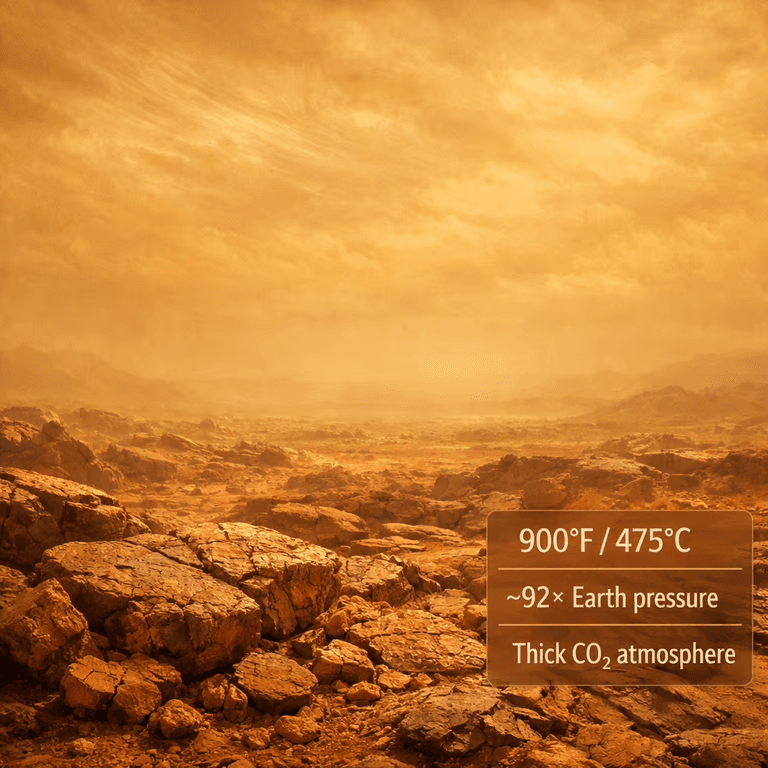
Venus' dense CO2 atmosphere causes extreme greenhouse warming, with surface temperatures averaging around 867°F (464°C). This is hotter than Mercury, despite being further from the Sun. Venus' clouds reflect sunlight, yet trap heat efficiently.
3. Venus: Atmospheric Composition
Venus’ atmosphere is 96.5% carbon dioxide and 3.5% nitrogen, with sulfuric acid clouds, creating high pressure and a thick greenhouse effect.
Venus
4. Venus: Temperature and Weather
Loading equations
Overview
5. Mars: Atmospheric Composition
Mars' atmosphere is 95% carbon dioxide, 2.6% nitrogen, and 1.9% argon. Its thin atmosphere differs from Earth's, which is mostly nitrogen and oxygen.
Mars
6. Mars: Temperature and Weather
Loading equations
Overview
7. Jupiter: A Gas Giant’s Temperature
Jupiter lacks a solid surface and has a cold outer atmosphere at around -234°F (-145°C). However, it radiates more heat than it receives from the Sun, due to gravitational compression and slow contraction of the planet’s mass.
Jupiter
8. Jupiter: Atmospheric Composition
Jupiter's atmosphere is mainly hydrogen and helium, unlike Earth's nitrogen and oxygen-rich atmosphere. Trace gases include methane and ammonia.
9. Jupiter: Temperature and Storms
Loading equations
Comparison
10. Comparative Composition Analysis
Earth's 78% nitrogen and 21% oxygen atmosphere contrasts with Mars’ carbon dioxide-rich and Jupiter’s hydrogen-rich atmospheres.
11. Earth: Diverse Climate Variations
Earth's average temperature is about 59°F (15°C), with considerable variation due to diverse climates. The presence of liquid water and a balanced greenhouse effect are key to sustaining life, unlike other planets.
12. Temperature and Weather Patterns
Loading equations



 Planetary Atmospheres