 Bitcoin vs Ethereum vs Solana
Slideshow
Edit
1. Three Questions
2. Bitcoin Purpose
3. Ethereum Purpose
4. Solana Purpose
5. Consensus Contrast
6. Security Assumptions
7. Decentralization Trade-offs
8. Fees and UX
9. Finality and Settlement
10. Typical Use Cases
11. Risk: Market and Liquidity
12. Risk: Smart Contracts
13. Risk: Centralization and Governance
14. Balanced Close
Setup
1. Three Questions
Alex opens his laptop and decides to stop answering “which crypto is best?” with a ticker. He frames the talk as three questions: what is each chain meant to do, what trade-offs does it accept to do it, and what risks follow from those choices. His goal is to give friends a map, not a slogan, so they can match a network to a real use case.
Chain Roles
2. Bitcoin Purpose
Alex starts with Bitcoin as digital gold with a job description: preserve value over long periods and provide a settlement network that prioritizes predictability over bells and whistles. He describes it as conservative by design, optimized for durability and censorship resistance, where the “feature” is stability and the main action is final settlement rather than app experimentation.
3. Ethereum Purpose
Alex explains Ethereum as a general smart-contract platform: a shared computer where developers build dApps, tokens, DeFi markets, NFTs, DAOs, and on-chain games. He emphasizes the huge ecosystem and composability—apps plugging into other apps—while noting that this flexibility brings complexity, competition for block space, and ongoing upgrades to scale without losing credible neutrality.
4. Solana Purpose
Alex introduces Solana as a high-speed chain aimed at low fees and consumer-scale apps, where throughput and fast user experience are first-class goals. He describes it like a busy highway built for frequent, small interactions—trades, mints, messages, games—accepting stricter hardware demands and different decentralization pressures so the average user can do more without thinking about gas spikes.
Core Comparisons
5. Consensus Contrast
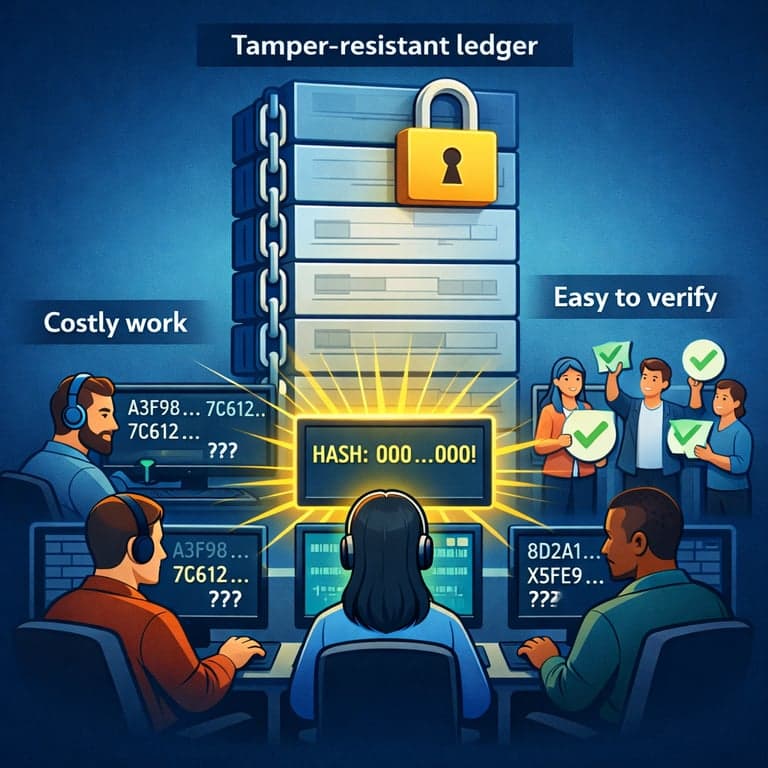
Alex compares how they agree on history. Bitcoin relies on proof-of-work mining to make rewriting the past expensive. Ethereum uses proof-of-stake validators to secure blocks with staked collateral and penalties. Solana also uses proof-of-stake but leans into a high-performance design to keep blocks flowing quickly. Alex stresses that consensus shapes who can participate and what attacks look like.
6. Security Assumptions
Alex says each chain’s safety rests on different assumptions. Bitcoin assumes energy and hardware costs deter attackers and that social consensus defends the rules. Ethereum assumes staked value, slashing, and client diversity protect the chain, plus a culture of rapid bug response. Solana assumes fast production and validator performance can stay robust under load, while mitigating outages and client risks.
7. Decentralization Trade-offs
Alex warns that decentralization isn’t a single dial; it’s about how many independent parties can run nodes, validate, and influence upgrades. Bitcoin’s simplicity helps broad participation but limits expressiveness. Ethereum balances decentralization with programmability, shifting some scaling to rollups. Solana’s performance can raise hardware and bandwidth requirements, potentially narrowing validator diversity if not managed.
User Experience
8. Fees and UX
Alex moves to the pain friends actually feel: fees. Bitcoin fees can rise when blocks are full, and it’s not built for constant micro-actions on-chain. Ethereum fees fluctuate with demand for execution and data, though rollups can reduce costs for many users. Solana often keeps fees low for routine activity, which supports consumer apps but depends on sustained network reliability.
9. Finality and Settlement
Alex explains finality as “when you can sleep at night.” Bitcoin offers strong settlement after multiple confirmations, trading speed for confidence. Ethereum offers faster practical finality with proof-of-stake checkpoints, and many apps treat it as final quickly while still respecting reorg risk. Solana aims for rapid finality-like user experience, but Alex notes speed must be weighed against stability history.
Use Cases
10. Typical Use Cases
Alex paints everyday matches: Bitcoin for long-term holding, large transfers, and base-layer settlement—often paired with Lightning for faster payments. Ethereum for DeFi, token issuance, stablecoins, on-chain identity experiments, and a deep developer stack, frequently with rollups for scale. Solana for high-frequency trading, consumer apps, gaming, social interactions, and low-friction mints where cost matters.
Key Risks
11. Risk: Market and Liquidity
Alex adds that “best” can change with market structure. Liquidity, exchange support, and stablecoin depth affect slippage and usability, especially during stress. Bitcoin often benefits from being the benchmark asset, Ethereum from being the settlement layer for much of DeFi, and Solana from vibrant retail ecosystems. Alex cautions that liquidity can evaporate fast in crises, hurting exits and collateral values.
12. Risk: Smart Contracts
Alex reminds everyone that code risk is real. Bitcoin’s simpler scripting reduces surface area, but second layers and custodial bridges can add risk. Ethereum’s richness invites bugs, governance surprises, and composability blow-ups where one failure cascades into others. Solana apps face similar contract and integration risks, plus fast-moving tooling. Alex urges using audits as a signal, not a guarantee.
13. Risk: Centralization and Governance
Alex highlights soft power: who runs infrastructure, who ships clients, and who can pressure validators. Bitcoin governance is slow and conservative, which reduces change risk but can stall upgrades. Ethereum evolves faster, which can improve tech but raises coordination risk. Solana’s rapid iteration can be an advantage, yet concentration among large operators, RPC providers, or key teams can amplify governance shocks.
Conclusion
14. Balanced Close
Alex ends by refusing to crown a winner. If a friend wants long-term, minimal-change settlement, Bitcoin often fits. If they want the broadest smart-contract economy and composable finance, Ethereum is usually the default. If they want low-fee, fast interactions for consumer apps, Solana can shine. Alex repeats his rule: pick the chain whose trade-offs match your goal—and size risk accordingly.







 Bitcoin vs Ethereum vs Solana