 Introduction to Superconductors
Slideshow
Edit
1. What is a superconductor?
2. Electrical resistance vs. zero resistance
3. Critical temperature (Tc)
4. Meissner effect (perfect diamagnetism)
5. Critical magnetic field and critical current
6. Type I vs Type II superconductors
7. Cooper pairs (simple picture)
8. Energy gap and why scattering stops
9. Flux quantization (vortex concept)
10. Persistent current demonstration example
11. Magnetic levitation example (Meissner + pinning)
12. Why superconductors matter: powerful magnets
13. Why superconductors matter: power and grids
14. High-temperature superconductors and cooling
15. Limits and challenges (brittleness, cost, quench)
Foundations
1. What is a superconductor?
A superconductor is a material that, below a certain critical temperature, enters a special “superconducting state” where electric current can flow without energy loss from resistance. It is not just a very good conductor; it is a different phase of matter with new electromagnetic behavior. This state can be destroyed if temperature, magnetic field, or current become too large.
Core physics
2. Electrical resistance vs. zero resistance
In normal metals, electrons scatter off vibrating atoms and defects, causing resistance and heating. In a superconductor, the DC electrical resistance drops to exactly zero, so a current can persist without a power source in a closed loop. This is why superconducting magnets can run steadily once “charged,” with minimal energy input to maintain low temperature.
3. Critical temperature (Tc)
Loading equations
4. Meissner effect (perfect diamagnetism)
Loading equations
5. Critical magnetic field and critical current
Superconductivity has limits: if the applied magnetic field exceeds a critical value, superconductivity breaks down and the material becomes normal. Similarly, if the current is too large, it can generate fields/heat that destroy the superconducting state. These “critical” values explain why real devices specify maximum field and current ratings for safe operation.
Materials
6. Type I vs Type II superconductors
Type I superconductors expel magnetic fields strongly but usually fail at relatively low fields, making them less practical for strong magnets. Type II superconductors allow magnetic flux to enter in quantized vortices between two critical fields, letting them remain superconducting under much stronger fields. Most superconducting technologies (MRI, accelerators) rely on Type II materials.
Microscopic ideas
7. Cooper pairs (simple picture)
A student-friendly explanation: in many superconductors, electrons effectively “pair up” into Cooper pairs due to an attractive interaction mediated by lattice vibrations. Paired electrons act collectively like a single quantum state that can flow without scattering the way individual electrons do. The key idea is collective, coordinated motion rather than independent particles bumping around.
8. Energy gap and why scattering stops
Loading equations
9. Flux quantization (vortex concept)
In Type II superconductors, magnetic flux penetrates in tiny “tubes” called vortices, each carrying a fixed amount of flux. This quantization is a hallmark of superconducting quantum behavior and helps explain magnetic levitation stability and magnet performance. Vortex motion can cause losses, so practical superconductors are engineered to “pin” vortices in place.
Experiments & demos
10. Persistent current demonstration example
A classic experiment is a superconducting ring: cool it below \(T_c\), induce a current, then remove the power source. The current can persist for extremely long times because there is no resistive dissipation. This demonstration visually contrasts normal loops (current decays) with superconducting loops (current remains), reinforcing the meaning of zero resistance.
11. Magnetic levitation example (Meissner + pinning)
A magnet levitating over a cooled superconductor is a widely used classroom demo. The Meissner effect pushes magnetic fields out, while in many Type II materials, vortex pinning “locks” the magnet’s position, allowing stable levitation even upside down on a track. This gives an intuitive picture of field expulsion and the special magnetic response of superconductors.
Applications
12. Why superconductors matter: powerful magnets
Because superconducting coils can carry huge currents without resistive heating, they can generate very strong, steady magnetic fields efficiently. This enables MRI scanners in medicine, particle accelerator magnets, and fusion research devices. The main operating cost is refrigeration, not electrical power lost to heating, making superconductors valuable where strong magnets are essential.
13. Why superconductors matter: power and grids
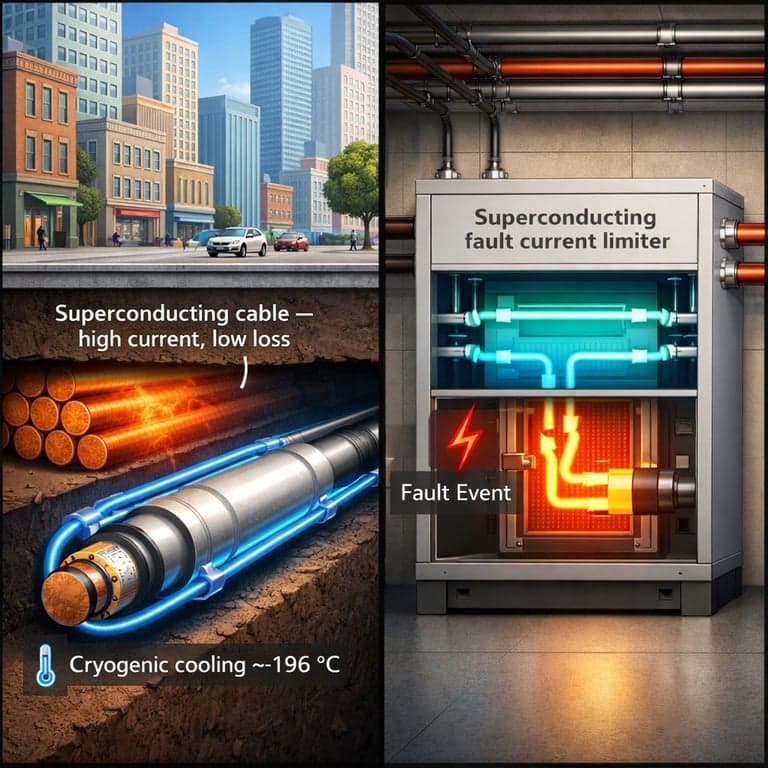
Superconducting cables can, in principle, transmit large currents with far lower losses than conventional lines. Superconducting fault current limiters can protect grids by quickly increasing impedance during faults. While cooling and material costs limit widespread adoption, these technologies matter in dense urban areas or specialized high-power settings where efficiency and space are critical.
Materials
14. High-temperature superconductors and cooling
“High-\(T_c\)” superconductors still require cooling, but they can operate with liquid nitrogen (around 77 K), which is cheaper and simpler than liquid helium. This lowers barriers for real-world devices such as power cables and compact magnets. The term “high temperature” is relative—these materials are still far below room temperature, motivating ongoing research.
Engineering & challenges
15. Limits and challenges (brittleness, cost, quench)
Many superconductors are brittle ceramics that are hard to manufacture into flexible wires, and all require cryogenic systems. If a superconductor suddenly becomes normal (a “quench”), resistance appears and rapid heating can damage equipment, so protection circuits are needed. These engineering challenges explain why superconductors are used where their unique benefits outweigh complexity.



 Introduction to Superconductors