 Cell Biology
Slideshow
Edit
1. Discovery of cells and origin of the term
2. Microscope observations using onion epidermis (temporary mount)
3. Unicellular vs multicellular organisation
4. Cells arise from pre-existing cells (continuity of life)
5. Cell theory and milestones in cell biology
6. Variation in cell shape and size relates to function
7. Cell organelles and division of labour within a cell
8. Plasma membrane as selectively permeable barrier
9. Diffusion and gaseous exchange across membranes
10. Osmosis and tonicity effects: hypo-, iso-, hypertonic solutions
11. Osmosis experiments: de-shelled egg and raisins/apricots
12. Cell wall: cellulose structure, protection, and plasmolysis
13. Nucleus, chromosomes, DNA, and genes
14. Prokaryotes vs eukaryotes and the nucleoid concept
15. Major organelles and their key functions (ER, Golgi, lysosomes, mitochondria, plastids, vacuoles)
History of Cell Biology
1. Discovery of cells and origin of the term
In 1665, Robert Hooke observed a thin slice of cork under a self-designed microscope and noticed honeycomb-like compartments, which he named “cells.” The term comes from the Latin word for “a little room,” and this observation was pivotal because it was the first evidence that living things are composed of discrete units, a concept still central to biology today.
Microscopy & Laboratory Examples
2. Microscope observations using onion epidermis (temporary mount)
A classic way to see cells is to prepare a temporary mount of onion peel: peel the inner epidermis, keep it in water to prevent folding/drying, place it flat on a slide with a drop of water, stain with safranin, and add a coverslip carefully to avoid air bubbles. Under low then high power, brick-like onion cells become visible, demonstrating that tissues are made of repeating cellular units.
Cell as Unit of Life
3. Unicellular vs multicellular organisation
Some organisms consist of a single cell that performs all life functions (unicellular), such as Amoeba, Chlamydomonas, Paramoecium, and bacteria. In multicellular organisms (many fungi, plants, animals), cells group together and specialize, forming tissues and organs with division of labour. This explains how complex body parts arise from coordinated activity of many differentiated cells.
Cell Theory & Core Principles
4. Cells arise from pre-existing cells (continuity of life)
A key idea emphasized is that every multicellular organism originates from a single cell, and new cells are produced when existing cells divide. This principle explains growth, repair, and reproduction at the cellular level and supports the concept that cellular lineage is continuous: all cells come from pre-existing cells rather than appearing spontaneously.
History of Cell Biology
5. Cell theory and milestones in cell biology
Cell theory states that plants and animals are composed of cells and that the cell is the basic unit of life, proposed by Schleiden (1838) and Schwann (1839), and expanded by Virchow (1855) who argued cells arise from existing cells. Other milestones include Leeuwenhoek’s first observation of free-living cells (1674), Brown’s discovery of nucleus (1831), Purkinje’s “protoplasm” (1839), and electron microscope use (1940) revealing organelles.
Cell Diversity & Function
6. Variation in cell shape and size relates to function
Cells differ widely in size and shape depending on what they do: Amoeba can change shape, while nerve cells have a characteristic elongated form suited for conducting impulses. Even within one organism, different tissues contain specialized cells (e.g., blood cells, bone cells, smooth muscle cells, sperm, ovum), illustrating how structure supports function across cell types.
Cell Structure Overview
7. Cell organelles and division of labour within a cell
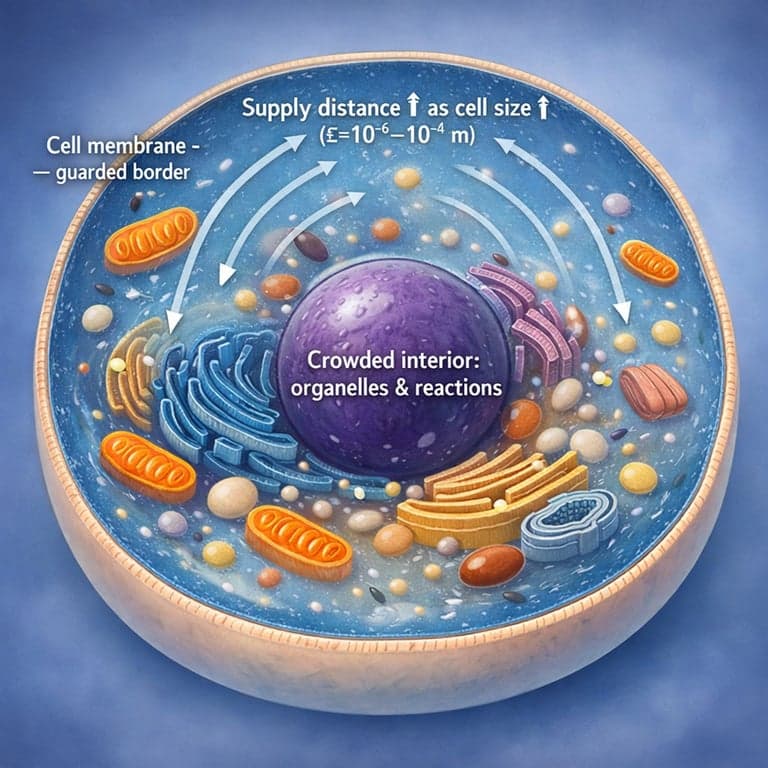
Just as organs in the body specialize, a single cell contains organelles that perform distinct tasks—making new materials, packaging products, and removing wastes—allowing the cell to survive and function. This internal division of labour explains how complex biochemical processes can occur efficiently within the limited space of a cell, and why organelle integrity is essential for life processes.
Membranes & Transport
8. Plasma membrane as selectively permeable barrier
The plasma membrane is the outer boundary separating a cell from its environment, regulating what enters and exits. Because it permits some substances to pass while restricting others, it is called selectively permeable. Its flexibility and composition (lipids and proteins) support controlled exchange and interactions with surroundings, forming the basis for homeostasis at the cellular level.
9. Diffusion and gaseous exchange across membranes
Diffusion is the spontaneous movement of substances from higher to lower concentration and is crucial for gas exchange in cells. For example, CO2 produced as waste can diffuse out when its concentration is higher inside the cell than outside, while O2 can diffuse in when internal O2 levels drop. This simple mechanism enables essential respiration-related exchange without energy expenditure.
10. Osmosis and tonicity effects: hypo-, iso-, hypertonic solutions
Osmosis is the net diffusion of water across a selectively permeable membrane toward higher solute concentration. In hypotonic solutions (more water outside), cells gain water and swell; in isotonic solutions, there is no net change; in hypertonic solutions (less water outside), cells lose water and shrink. These outcomes explain why cell size and turgor depend strongly on external solute conditions.
Microscopy & Laboratory Examples
11. Osmosis experiments: de-shelled egg and raisins/apricots
Removing an egg shell with dilute HCl leaves a semipermeable membrane; in pure water the egg swells as water enters by osmosis, while in concentrated salt solution it shrinks as water exits to the more concentrated medium. Similarly, dried raisins/apricots swell in water and shrink in concentrated sugar/salt, providing visible, everyday demonstrations of osmotic water movement across biological barriers.
Plant Cell Features
12. Cell wall: cellulose structure, protection, and plasmolysis
Plant cells have a rigid cell wall outside the plasma membrane, mainly made of cellulose, providing mechanical strength. In hypertonic conditions, living plant cells may show plasmolysis—cell contents shrink away from the wall due to water loss. Cell walls help plant, fungal, and bacterial cells withstand hypotonic environments by resisting bursting as incoming water builds pressure (turgor) against the wall.
Genetic Control & Nucleus
13. Nucleus, chromosomes, DNA, and genes
The nucleus, bounded by a double-layered nuclear membrane with pores, directs cell activities and reproduction. It contains chromosomes—DNA and protein structures visible during division—carrying hereditary information. In non-dividing cells, DNA exists as chromatin (thread-like network) that condenses into chromosomes before division; functional DNA segments are genes, which encode information needed to construct and organize cells.
Cell Types: Prokaryotic vs Eukaryotic
14. Prokaryotes vs eukaryotes and the nucleoid concept
In bacteria, the nuclear region is not enclosed by a nuclear membrane, forming an ill-defined nucleoid; such organisms are prokaryotes. Eukaryotes have a well-defined nucleus with a nuclear membrane and possess membrane-bound organelles. Prokaryotes generally lack these organelles, and even photosynthetic prokaryotes associate chlorophyll with membranous vesicles rather than plastids, highlighting fundamental organizational differences between cell types.
Cell Organelles & Functions
15. Major organelles and their key functions (ER, Golgi, lysosomes, mitochondria, plastids, vacuoles)
RER (with ribosomes) makes proteins; SER synthesizes lipids and can detoxify drugs (noted in liver cells). Golgi stacks modify, package, and dispatch products and help form lysosomes. Lysosomes digest foreign material and worn-out organelles and may cause self-digestion (“suicide bags”). Mitochondria generate ATP and have their own DNA/ribosomes; plastids (chloroplasts/leucoplasts) in plants handle photosynthesis and storage; vacuoles store cell sap/food and support plant turgidity (often 50–90% volume).



 Cell Biology