
Butterfly Effect Basics
Edit
1. 1. What the Butterfly Effect Means
2. 2. Sensitive Dependence on Initial Conditions
3. 3. Why Weather Is Chaotic
4. 4. A Simple Weather Chain Reaction
5. 5. Nonlinear Systems
6. 6. Feedback Loops
7. 7. Order Inside Chaos
8. 8. Limits of Long-Term Prediction
9. 9. Chaos Is Not Randomness
10. 10. Chaos Is Not Fate
1. 1. What the Butterfly Effect Means
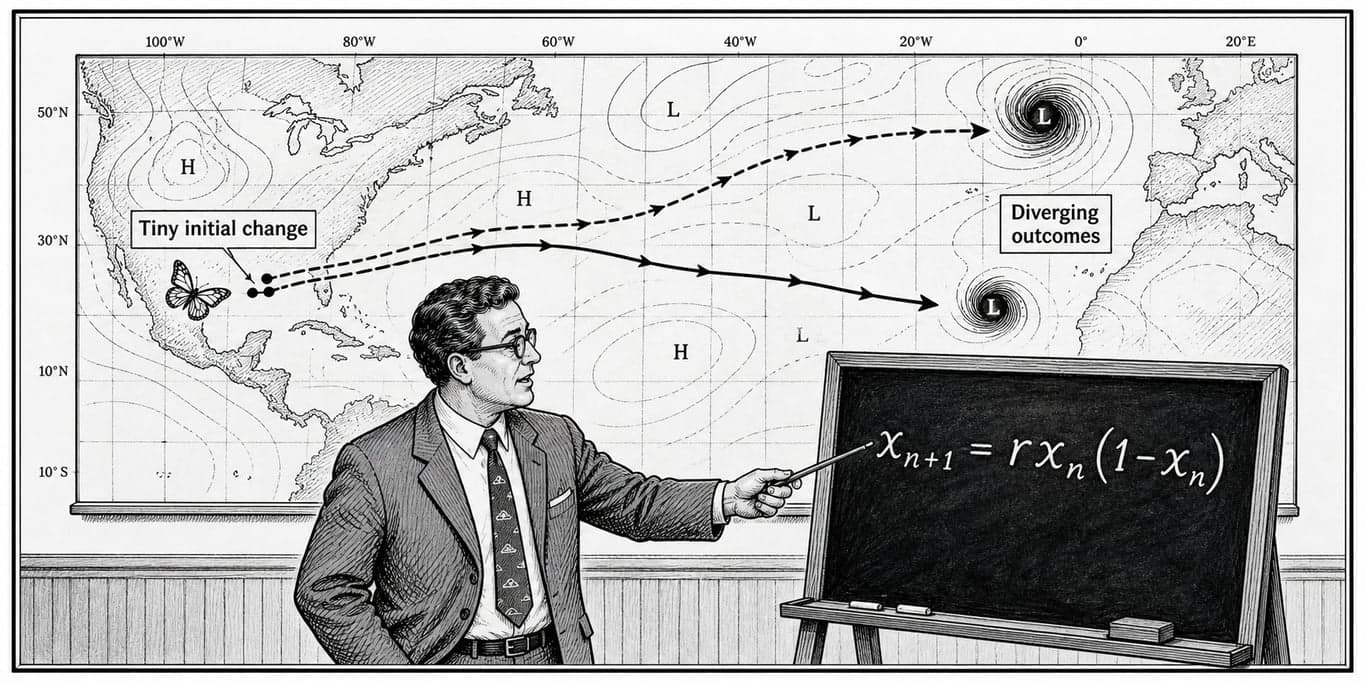
The butterfly effect is the idea that a tiny difference at the start of a process can grow into a large difference later, especially in systems like weather, ecosystems, or moving fluids. The famous image of a butterfly flapping its wings and later affecting a storm is not meant to say one insect directly “causes” a hurricane by itself. Instead, it shows that the atmosphere is so interconnected that very small changes can become part of a much larger chain of events. In everyday terms, it is like starting two nearly identical snowballs rolling down a bumpy hill: at first they move almost together, but small differences in bumps, speed, and direction can send them to very different places. The key lesson is that some systems follow laws of science yet are still hard to predict far into the future because tiny measurement errors can become important.
Does the butterfly effect mean everything is caused by tiny events?
Is the butterfly effect only about weather?
Landscape
Fullscreen
2. 2. Sensitive Dependence on Initial Conditions
Loading equations
Why can’t scientists just measure the initial conditions more carefully?
Does sensitive dependence happen instantly?
Landscape
Fullscreen
3. 3. Why Weather Is Chaotic
Weather is chaotic because the atmosphere is a moving mixture of gases, heat, moisture, pressure, and sunlight, all interacting at once across many distances. A warm patch of ground can heat nearby air, rising air can change pressure, changing pressure can redirect winds, and new winds can move clouds and moisture elsewhere. These processes involve motion and direction, so a small change in wind speed or the location of a cloud can alter what happens nearby and then influence larger regions. Weather is not random in the sense of having no causes; it follows physical laws such as conservation of energy and fluid motion. However, because the atmosphere has countless interacting parts, a small local change may spread through the system. This is why a forecast for tomorrow is usually much more reliable than a forecast for the same day two months from now.
Why are weather forecasts often accurate for only a few days?
Does chaos mean meteorologists are guessing?
Landscape
Fullscreen
4. 4. A Simple Weather Chain Reaction
A simple weather example begins with a small temperature difference over a field. If one area warms slightly more than another, the warmer air becomes less dense and rises. As it rises, nearby air moves in to replace it, creating a small breeze. That breeze can carry moisture, shift a cloud’s position, or change where cooling occurs. If the conditions are already close to producing rain, the small shift might help a cloud grow in one place rather than another. This does not mean the first warm patch single-handedly created a storm; many other conditions must be present, including moisture, unstable air, and larger pressure patterns. The butterfly effect works best when a system is near a tipping point, where several outcomes are possible and a small nudge can influence which outcome develops.
Can one tiny change create rain from nothing?
Why do small effects sometimes fade instead of grow?
Landscape
Fullscreen
5. 5. Nonlinear Systems
Loading equations
Why are nonlinear systems harder to predict?
Can a simple equation really behave chaotically?
Landscape
Fullscreen
6. 6. Feedback Loops
Feedback loops happen when the result of a process feeds back into the process itself. In positive feedback, a change strengthens itself, like warming that melts ice, reducing reflection of sunlight and allowing more warming. In negative feedback, a change limits itself, like a thermostat turning off heat when a room gets warm enough. Chaotic systems often contain many feedback loops working at the same time, some amplifying changes and others damping them. In weather, rising warm air can help form clouds; clouds may block sunlight and cool the surface, but they may also trap heat or release energy as rain forms. Because feedback effects can compete, the final outcome may be difficult to know in detail. Feedback loops help explain how small changes sometimes grow, sometimes disappear, and sometimes produce surprising shifts in a system’s behavior.
Is positive feedback always good?
Can negative feedback prevent chaos?
Landscape
Fullscreen
7. 7. Order Inside Chaos
Chaotic systems are not the same as systems with no order at all. They may be unpredictable in exact detail while still showing patterns, boundaries, and repeated tendencies. For example, weather cannot be predicted precisely months ahead, but seasons are still recognizable because Earth’s tilt and orbit create regular changes in sunlight. In chaos theory, a system may move through a range of possible states without wandering everywhere. Scientists describe this using ideas such as attractors, which are patterns that a system tends to follow over time. The path may never repeat exactly, but it may stay within a recognizable region of behavior. This is why climate, which concerns long-term averages and patterns, can be studied even though exact daily weather far in the future cannot be known.
How can chaos have order?
Why can climate be studied if weather is chaotic?
Landscape
Fullscreen
8. 8. Limits of Long-Term Prediction
The butterfly effect explains why long-term prediction has limits, even with powerful computers. A computer model must begin with measurements, but real-world measurements are never complete or perfectly exact. In a chaotic system, those tiny uncertainties grow until the model no longer matches the exact future state. This is why forecasters often use ensembles: they run many simulations with slightly different starting conditions and compare the range of possible outcomes. If most simulations agree, confidence is higher; if they spread apart quickly, uncertainty is larger. The goal is not to know one perfect future but to estimate likely possibilities and risks. This approach is useful in weather, disease spread, ecosystems, and other complex systems where prediction becomes less about certainty and more about informed probability.
Will better computers remove the butterfly effect?
Why do forecasts give probabilities instead of certainties?
Landscape
Fullscreen
9. 9. Chaos Is Not Randomness
Chaos can look random, but it is different from true randomness. A chaotic system follows rules: if the starting conditions were known with perfect accuracy, the same rules would produce the same result every time. Randomness means outcomes are not fully determined by a predictable rule, or at least are treated as chance events. A shuffled deck, radioactive decay, and a chaotic weather model may all be uncertain to us, but the reasons for uncertainty are different. In chaos, the main problem is that tiny differences in starting information grow too large to ignore. This is why chaos is sometimes called deterministic unpredictability: the system is rule-governed, yet exact long-term prediction becomes impossible in practice. Understanding this difference prevents the mistake of thinking that “chaotic” means completely lawless or meaningless.
If chaos follows rules, why does it seem random?
Is rolling dice chaotic or random?
Landscape
Fullscreen
10. 10. Chaos Is Not Fate
The butterfly effect also differs from fate. Fate suggests that events are fixed in a meaningful or unavoidable way, often regardless of choices. Chaos theory says something more scientific and less mystical: systems may be highly sensitive, so small differences can change outcomes. It does not claim that every event was destined or that every tiny action has a dramatic result. Many small changes fade away, and many large outcomes require large background conditions. The butterfly effect should encourage humility about prediction, not a belief that life is controlled by hidden destiny. It also does not prove that one person’s smallest action will certainly transform the world. Instead, it shows that in complex systems, influence can be indirect, outcomes can be uncertain, and certainty about the far future is limited. Chaos leaves room for causes, probabilities, and choices without turning them into fate.
Does the butterfly effect mean everything happens for a reason?
Can small choices matter in real life?
Landscape
Fullscreen
What do you want to learn today ?
Create your first visual book and get started