 Bitcoin Basics
Slideshow
Edit
1. Bitcoin in Plain Terms
2. What Problem It Solves
3. Trust vs Proof
4. Addresses and Ownership
5. What a Transaction Is
6. Why Double-Spending Matters
7. The Shared Ledger (Blockchain)
8. Miners and “Work”
9. Proof of Work
10. Why Confirmations Increase Safety
11. Why Miners Participate
12. Buying and Selling Bitcoin
13. Sending and Receiving Payments
14. Privacy in Everyday Use
15. Wallet Types and Tradeoffs
Overview
1. Bitcoin in Plain Terms
Bitcoin is digital money you can send over the internet directly to another person, without needing a bank or payment app to approve it. Instead of one company keeping the “official” balance sheet, many computers share the same public record of transactions, so the network can agree on who owns what.
Motivation
2. What Problem It Solves
Online payments often depend on trusted middlemen who can block, delay, or reverse transfers. That adds fees, paperwork, and risk for sellers. Bitcoin was created to let value move like cash—more direct and harder to undo—so payment approval doesn’t rely on a single organization’s decision.
Core Idea
3. Trust vs Proof
With Bitcoin, you don’t “trust the bank”; you rely on proof. The system uses math and shared checking so anyone can verify that a payment was authorized and that the same funds weren’t already spent. This shifts power from private rules and disputes toward transparent verification.
4. Addresses and Ownership
People control bitcoin using wallets that manage secret keys. A Bitcoin address is like an account number you can share to receive money, while the secret key is like the only valid signature that can spend it. If you lose the key, you lose access; if someone steals it, they can spend your funds.
How It Works
5. What a Transaction Is
A transaction is a public message that says, in effect, “move this amount from my control to someone else.” It can also include a “change” amount back to you, similar to paying with a bill and getting change. Once broadcast, the network checks basic rules before treating it as valid.
6. Why Double-Spending Matters
Ledger
7. The Shared Ledger (Blockchain)
8. Miners and “Work”
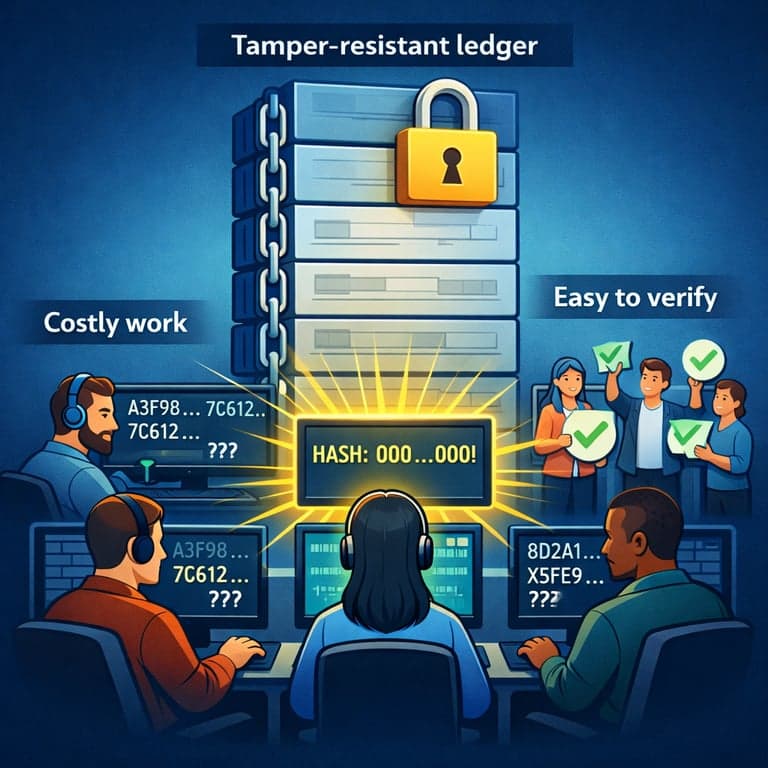
Some participants, called miners, compete to add the next page of transactions to the ledger. They do this by running a costly guessing process that’s hard to do but easy for everyone else to verify. Because it’s expensive to redo, this “work” helps protect the ledger from tampering.
9. Proof of Work
Security
10. Why Confirmations Increase Safety
When your transaction first appears in the ledger, it’s considered included but not fully settled. As more new blocks are added after it, reversing it becomes increasingly difficult because an attacker would need to replace not just one block, but many. Waiting for more confirmations means more confidence.
Incentives
11. Why Miners Participate
Miners are rewarded for adding valid blocks. Part of the reward comes from newly issued bitcoin, and part can come from transaction fees paid by users. These incentives encourage miners to spend resources securing the network, because honest participation is how they earn rewards. Initially, miners earned 50 bitcoins per block. This reward halves approximately every four years, emphasizing the growing role of transaction fees.
How People Use It
12. Buying and Selling Bitcoin
Many people get bitcoin through exchanges or broker apps: you deposit local currency, buy bitcoin, and withdraw it to your own wallet if you want full control. Selling is the reverse. Some people also trade directly with others, but they typically use escrow or trusted platforms to reduce fraud.
13. Sending and Receiving Payments
Privacy
14. Privacy in Everyday Use
Bitcoin is not fully anonymous: transactions are public, and observers can track movements between addresses. Privacy mainly comes from using addresses that aren’t directly tied to your real identity and by reusing addresses less often. Still, patterns can reveal links, especially when funds are combined.
Practical Basics
15. Wallet Types and Tradeoffs
Wallets range from custodial (a company holds keys for you) to self-custody (you hold your own keys). Custodial wallets are easier to recover but require trusting the provider. Self-custody offers more control and fewer permission risks, but you must secure backups and protect keys yourself.






 Bitcoin Basics